|
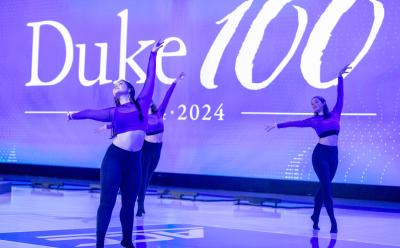
| Singing out: Sonali Hippalgaonkar, left,
rehearses with a cappella group Dèjà Blue |
| photo by Jon Gardiner |
|
isten
to one of Duke's vocal groups, The Pitchforks, sing "Good
Old A Cappella" on their 1998 CD Tastefully Done. Male harmony
sings, "Shoo-bee-doo-wop, bop, bop... soul to soul, brother
to brother, a cappella, well, it sounds good to me." You might
think you're back in the Fifties, in the days of barbershop quartets,
sweet Adelines, and "Down by the Old Mill Stream." But
a quick glance at The Pitchforks' repertoire, which includes covers
of songs by Toad the Wet Sprocket, Dire Straits, Lenny Kravitz,
and Marc Cohn, provides clear evidence that this isn't your grandfather's
a cappella.
A cappella--music made only with the voice--has experienced
a boom in the last decade. According to the Contemporary A Cappella
Society
(CASA), there are now more than 500 collegiate groups. Deke Sharon,
president of CASA and musical director for The House Jacks, a professional
a cappella group, says, "A cappella music has been around
longer than any other form and is a part of every culture and tradition
around the globe. To the outside world, however, a cappella usually
connotes barbershop, doo-wop, or choral music--none of which accurately
represents many current groups."
Performers and music executives trace the origins of this interest
back to one man and one song--Bobby McFerrin and his 1988 chart-topper, "Don't
Worry, Be Happy." McFerrin's ability to create a broad range
of sounds without instruments in addition to singing lyrics opened
many listeners' ears to the possibilities of the human voice. He
pioneered what a cappella enthusiasts call "vocal percussion," the
art of expressing rhythm with nothing but your lips, tongue, and
voice. His playfulness appealed to young singers and, with the
rise of rhythm-driven music like rap and hip-hop, college students
found they could create innovative music, replicating and expanding
on contemporary songs without instrumental accompaniment.
Much of the growth in a cappella music has been fueled by college
groups like those at Duke, including the oldest groups, the all-male
Pitchforks (founded in 1979) and the all-female Out of the Blue
(founded in 1980). Other campus groups are Lady Blue; Speak of
the Devil; Something Borrowed, Something Blue; DÈj‡ Blue;
and Rhythm and Blue.
Why do students gravitate toward these groups? Former Pitchforks'
member and business manager Bret Runestad '02 has one answer: getting
to sing, but getting to sing with a certain style. "I did
a lot of more formal singing in high school, both for my school
choir and for a more exclusive, smaller madrigal ensemble," he
says. "While I loved being a part of that, when I went home
at night, the music I was listening to was a far cry from the classical
and formal pieces I was singing. When I arrived at Duke, I retained
a desire to sing, but I also had a real desire to loosen up and
have more fun with it and sing more contemporary material. A cappella
was the logical extension."
Dave Chong '03, of Something Borrowed, Something Blue, first felt
the pull of a cappella during a visit to campus while a senior
in high school. "My host was in Lady Blue, so I got to see
them and The Pitchforks perform," he says. "This was
a very cool way of musical expression. They all looked like they
were having fun, enjoying singing and each other. Half of the appeal
of a cappella is image. You can't help but think to yourself, 'Heck,
if I could sing like that--and, more recently, dance like that--I'll
look good and get women. I'll be cool.' As vulnerable, clean-slated
freshmen, we all want to be liked, and there aren't many people
who dislike a cappella here at Duke. It's a tradition."
Each of the groups has a distinct idea of who they are and what
they sing, and the differences point to Runestad's idea of "loosening
up." The Pitchforks, for example, "maintain two repertoires
throughout the school year," he says, "a more modern
one for campus and dorm shows, and a more traditional 'oldies but
goodies' set for other occasions."
Out of the Blue was founded twelve years ago when four sophomores
were lamenting the lack of a women's counterpart to The Pitchforks.
According to the group's own history, Elisa Buono Glazer '83, Mary
Pat Evans '83, Harriet Cann Connolly '83, and Loa Heymann '83 fell
into a conversation about music, singing, and their love of a cappella,
and talked themselves into a group. That group still "places
emphasis on the musical aspect of a cappella," says Meg Watson
'02, business manager for the group before graduating. "We
have extremely difficult and layered arrangements, trying to stay
as true to the original song as possible. It has been noted to
us that this is the major point of separation between OOTB and
other female groups on campus."
The intricacies of a cappella harmonies contribute not only to
prominence but also to camaraderie, says Watson. "College
a cappella allows members of the group to become very close on
a musical and personal level. From practically the first day of
fall semester, as a freshman, I had a group of older female friends
to go to with questions," she says. "There's a reliance
on other members of the group that exceeds that in a normal chorus,
which--at least in Out of the Blue--has made us a close-knit group
of girls."
Another tight-knit group of a cappella women, Lady Blue, has a
website that describes them as "road-trip queens with hip
wardrobes and a penchant for outlet malls, karate, silly string,
dance parties (even without any great dance talent), and funky
pants."
continues on page
two. |