|
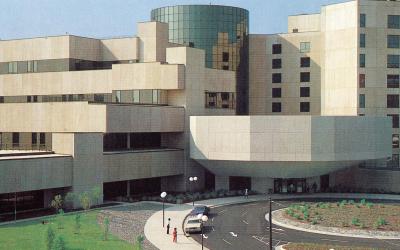
On the third floor of Duke North in Operating Room 4, neurosurgeon John Sampson is using what looks like a blunt, two-pronged fork to probe sections of a patient's exposed brain. Weeks earlier, an MRI had revealed a shadow near the front of the man's skull, an ominous intruder whose appearance on the black-and-white scan resembled a satellite view of an advancing hurricane. Sampson suspects a high-grade tumor, possibly a glioblastoma multiforme—the most common and deadliest form of brain cancer.
The tumor had been growing stealthily in the patient's head until, one day in April, the sixty-eight-year-old man sat down, exhausted, and could not get up. A flurry of medical tests and phone calls later, he is now at Duke Medical Center, in the hands of one of the top brain tumor surgeons in the world.
Because the growth is pushing against the left frontal lobe in an area that controls speech and facial expressions, Sampson is performing a craniotomy while the patient is awake, slowly and methodically cutting his way deeper and deeper into the brain. Throughout the three-hour operation, Sampson will rely on the patient's responses to cues to help guide catheters, aspirators, and three-dimensional imaging tools to target the spot where the burrowing tumor resides.
Under the layers and layers of surgical drapes that cover the patient, nurse practitioner Denise Lally-Goss huddles close to the man's face, talking gently. To the rest of the OR team, the voices are muffled, barely discernible. She holds up flash cards and prompts the man to identify what images are pictured.
"This is a…" says Lally-Goss.
"Frog," the man says.
"This is a…"
"Comb."
Through a hole in the patient's skull roughly the size of a computer mouse, Sampson and his surgical assistant are mapping out safe entry points through the brain's dura mater to get to the interior of the delicate frontal lobe. It's as if Sampson is in a house he knows like the back of his hand, but it's night, and all the electricity has gone off. The man's responses are like a dime-store flashlight, pointing Sampson toward safe passage, or warning him away from danger.
Then the patient starts missing cards.
"Two out of five," Lally-Goss calls out to Sampson.
And then, "Okay, he missed all five."
"Get him to count to ten," says Sampson.
No response.
Like a thunderclap, Sampson bellows the patient's name, commanding all the energy and attention in the beeping, humming operating room. "We need you to be loud. Tell me what's on the cards. This is a…"
"Chair!" exclaims the man, correctly.
"This is a…"
"Rabbit!"
"This is a…"
"Fork!"
Back on track. Sampson gently chides Lally-Goss. "Denise, this is no time to be using your indoor voice. I need you to really get in his face and keep him focused."
Two hours into the operation, Sampson has isolated the tumor, a white spongy contrast to the vibrant deep pink of its host. After the meticulous precision used to cut around the cancerous area, its removal is surprisingly quick. A section of the golf-ball-sized growth is whisked to the lab for analysis. Sampson and his colleagues use an ultrasound wand to scan the brain for residual tumor, then begin the process of closing up the groggy patient's head.
The initial lab analysis indicates what later tests confirm: a grade IV glioblastoma multiforme, a highly malignant, fast-growing cancer for which there is no cure. Most recur within six months. The vast majority of patients are dead within eighteen months.
Every year, between 10,000 and 20,000 people in the U.S. are diagnosed with glioblastoma multiforme (GBM) tumors. No one knows what causes them. They are primary tumors, meaning that they begin in the brain rather than metastasizing from somewhere else in the body. GBMs are insidious. They send tentacles into the brain, becoming inextricably wrapped around healthy tissue; even though neurosurgeons can remove what appears to be the bulk of the tumor, virulent cancer cells are invariably left behind. The usual course of treatment is removal (when possible), followed by radiation and chemotherapy. This standard of care has not changed significantly in nearly fifty years.
A native of Canada, John Sampson was recruited straight out of medical school at the University of Manitoba to join Duke Medical Center's neurosurgery residency program in 1990, and he's been here ever since. He sometimes tells people that he briefly considered becoming a general practitioner because he liked the idea of forging lifelong relationships with patients. But it's hard to imagine Sampson, or any of his colleagues at the Preston Robert Tisch Brain Tumor Center, for that matter, content with performing routine physicals and annual check-ups. Brain surgeons tend to be mavericks, tireless and intensely driven, offering patients the promise of hope when other doctors have exhausted all options.
continues on
page two.
|