|
Refining regional fare:Moreton
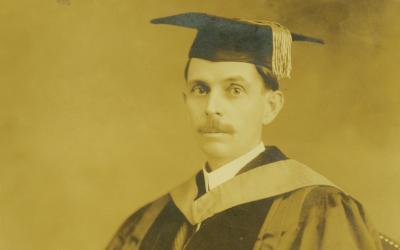
Neal at Crook's Corner, above, and Bill Neal, below
Photos: above,Chris Hildreth; below, courtesy of Gene Hamer |
 |
When Bill Neal arrived at Duke as a freshman in the fall of 1967,
the closest thing to fine dining in Durham was Hartman's Steak
House on Geer Street. Serious gourmets traveled to New York or
New Orleans to find a meal worth remembering.
These days, they make detours to dine in Triangle restaurants.
Whether they feast on shrimp and grits and jalapeÒo hush
puppies at Crook's Corner in Chapel Hill, revel in the green-tomato
soup with crab and country ham at Durham's Magnolia Grill, or savor
inventive and tasty food at restaurants from Charleston, South
Carolina, to Oxford, Mississippi, satisfied diners owe a debt to
Bill Neal. His legacy is receiving renewed attention more than
a decade after his death from AIDS at the age of forty-one.
A passionate chef, inspiring mentor, and articulate chronicler
of Southern fare, Neal made a mark with his Chapel Hill restaurants,
La Rèsidence and, later, Crook's Corner, helping to blaze
a trail that other talented cooks would soon follow. Going into
the food business "wasn't what your parents sent you to Duke
for," says Moreton Hobbs Neal '71, Bill Neal's classmate at
Duke, his wife and business partner for eleven years, and, after
their divorce, a friend. Cooking was regarded as blue-collar work,
and the notion that running a restaurant could be intellectually
stimulating seemed as far-fetched as the prospect of celebrating
corn bread and black-eyed peas as haute cuisine.
Moreton Hobbs met Neal in French class at Duke. He was hard to
miss, she recalls--his usual attire was a baggy red-and-yellow
Hawaiian bathing suit. Soon they were dating and discovering a
common interest in food, whether through their own experiments
in dormitory kitchens or by exploring local restaurants using Neal's
tip money from waiting tables at the Country Squire.
These adventures were augmented by visits to her family home in
southern Mississippi, a short train ride from the celebrated French
Creole restaurants of New Orleans. Day trips featuring breakfast
at Brennan's, lunch at Gallatoire's, and dinner at Antoine's or
Arnaud's opened new worlds for Bill Neal, whose dining-out memories
from a childhood in the Carolina Piedmont centered on barbecue
joints, fish camps, and other staples of rural Southern life. Later,
both broadened their culinary horizons while putting all those
French classes to use by dining their way through France.
Bill and Moreton married their senior year at Duke. After a year
of teaching high school, while Moreton stayed home with their first
baby, Bill decided to pursue graduate work in English at the University
of North Carolina at Chapel Hill. The couple began supplementing
the family budget by catering for faculty members. Before long,
the kitchen won out over the classroom, although Neal would always
find great pleasure in quoting favorite writers, from Homer to
Eudora Welty, in his conversation and his cookbooks.
Bill Neal dreamed of studying at the Cordon Bleu in Paris, but
the need to support a growing family intervened, and his education
as a chef came through on-the-job experience. Leaving graduate
school, he signed on as an apprentice cook at Chapel Hill's Villa
Teo, where, Moreton Neal writes, he was attracted by the glamour
of the restaurant's exotic ambience and intrigued by "the
'demimonde' of a college-town restaurant kitchen teeming with highly
educated eccentrics."
Within a year, he had risen to the position of chef de cuisine,
and Moreton was cooking under a French chef at Hope Valley Country
Club in Durham. By 1975, they were ready to open their own restaurant.
The Neals constructed a menu by combining the cooking techniques
they had learned on the job with the French practice of combing
local markets for the best fresh food of the day. He ran the kitchen,
while she took charge of desserts and, using an eye trained in
art classes at Duke, supervised the dècor.
Their restaurant, La Rèsidence, opened in the main house
of Jesse Fearrington's dairy farm, now Fearrington Village, just
south of Chapel Hill. It moved two years later to a house on West
Rosemary Street.
After the Neals divorced in 1982, Moreton managed the restaurant
until 1992, when new owners took over. Seven years later, she says,
they called to tell her they were thinking of selling, prompting
her to rescue the stained and faded cards that recorded the recipes
they developed in the early years of "La Res," as locals
still call it.
Moreton says she had intended to save those recipes for herself
and for the Neals' three children. But she realized that they reflected
the essence of Bill's approach to food and decided to publish them.
The result is a book in which she writes engagingly about the early
years and about the challenges and rewards of a culinary career.
Remembering Bill Neal: Favorite Recipes from a Life in Cooking
(University of North Carolina Press, 2004) is a memoir and recipe
compilation that complements Neal's own cookbooks. It includes
more than 150 recipes, most previously unpublished, for dishes
that Bill Neal perfected at La Rèsidence, Crook's Corner,
and at home.
Bill's own books--Bill Neal's Southern Cooking; Biscuits, Spoonbread,
and Sweet Potato Pie; and Good Old Grits--have remained steady
sellers, says David Perry, editor in chief of UNC Press. In many
quarters, they are regarded as classics, especially Bill Neal's
Southern Cooking, which was published in 1985, as interest in America's
regional foods was influencing the restaurant scene in cities throughout
the country. In 1989, UNC Press issued a revised and enlarged edition
of the book, which Perry says has enjoyed "a bit of a resurgence" as
more liberal-arts colleges add courses in food history and culture.
continues on
page two. |