|
| Telling Tales Out of School
by Tifenn Python |
A few days before fall break in October 2002,
sophomore Emily Faulkner* stayed up late studying for a biology
midterm in her room in Wannamaker residence hall. Around 5:20 a.m.
on October 9, she walked down the hall to the bathroom. She noticed
a young man in one of the stalls. She assumed it was someone's
boyfriend who was spending the night. It wasn't.
The man grabbed her. They struggled, and Faulkner tried to defend
herself with a penknife she kept on her keychain. The man turned
the knife against her, cutting her on the face, chest, arm, and
leg. He then sexually assaulted her.
The incident shook the Duke community. Undergraduate women began
traveling in pairs or groups to bathrooms. Based on Faulkner's
description of her assailant, and his presence in a residence-hall
bathroom accessible only with a student identification card, many
people speculated that the man was a Duke student. Despite extensive
police investigation, to this day, no one has been charged in the
incident.
A poised, friendly young woman, Faulkner, now a senior, is a Benjamin
N. Duke Scholar and a pre-med student interested in pediatrics
and women's health. She is also a statistic.
One in four women will be raped during her lifetime, according
to the American Association of University Women. One in six will
be the victim of a rape or attempted rape during her college career.
Unlike most victims, however, Faulkner didn't know her attacker.
And unlike most, she reported the assault to the police. By contrast,
90 percent of women nationally say they know the person who attacked
them, and 65 percent of attacks go unreported. The American Medical
Association has called sexual assault "the silent epidemic."
After taking a few weeks off to be at home with her mother in South
Carolina, Faulkner returned to campus. "I had very mixed feelings
about coming back to Duke," she says now. "A part of
me felt as though I could never go back to my room or be around
my friends again. But another part of me wanted to move on with
my life. I knew I wanted to go to medical school and was looking
forward to going abroad my junior year. I didn't want to give up
on everything I had worked so hard for."
With the encouragement of friends, Faulkner submitted a first-person
essay to The Chronicle in November of that year titled "Sexual
Assault Reality." She shared details about her own attack
and extended an invitation to other men and women affected by sexual
assault to send in their stories. "I was shocked by the response," she
says. "I heard from men, women, parents, friends of assault
survivors. After reading through them all, I knew I couldn't keep
these to myself. I wanted to share the range of experiences with
the rest of the campus."
With the contributors' consent, she and a group of students published
Saturday Night: Untold Stories of Sexual Assault at Duke in the
fall of 2003. One woman wrote about being raped on the eve of graduation
by a friend who had offered her a ride home. A black woman, raped
by a classmate, said she decided not to report it because she felt
it would reflect badly on the black community.
The book's frank and graphic portrayals of acquaintance rape--Duke
women being assaulted by Duke men--shone a harsh light on a grim
topic. The voices were angry, accusatory, and heartbreaking. Several
survivors wrote of feeling incredulous and detached as the assaults
took place. Others lambasted Duke for not doing enough to address
the problem. The book became something of a primer about sexual
assault for the Duke community and helped raise awareness about
the preponderance of assaults that occur between people who know
each other.
The following spring, a reported rape on West Campus added fuel
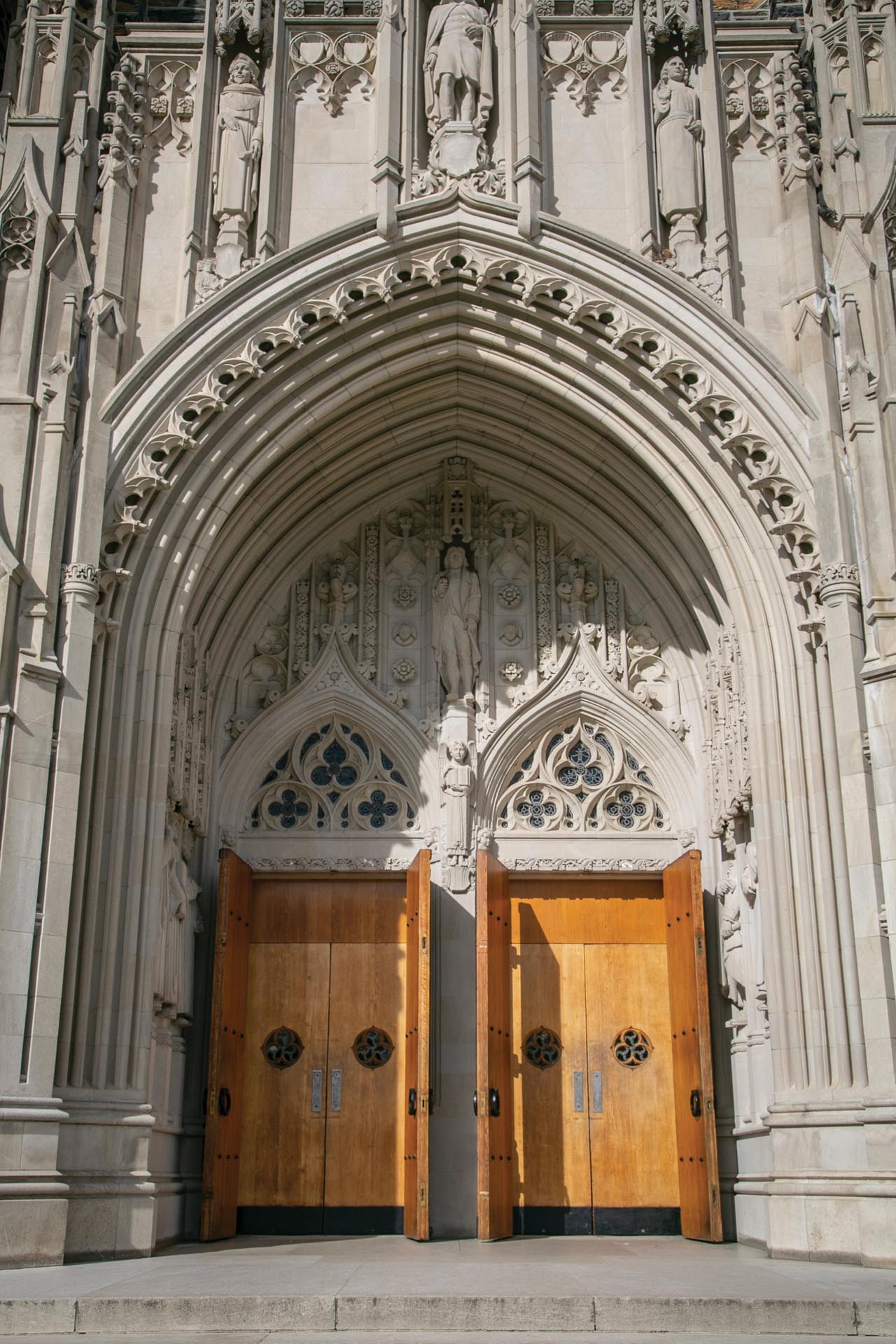
to the flame. At a "scream in" on the steps of Duke Chapel,
nearly 100 students, faculty members, and administrators screamed
for a full five minutes to express outrage over what student organizers
called the university's slow response to informing the community
about the incident. "These are screams of anger at the pervasiveness
of rape and violence towards women at Duke," said Alessandra
Colaianni, the freshman who organized the protest.
Less than a week later, the annual Sexual Assault Prevention Week
activities took on an added urgency because of the conversations
still taking place about Saturday Night and the most recent reported
assault. Events included the "pinwheel project," an installation
of pinwheels on West Campus representing the number of men and
women who will be sexually assaulted during their lifetimes; a
clothesline project displaying T-shirts designed by survivors;
and the "white ribbon" campaign, which encouraged men
to wear a white ribbon and sign a pledge that they would never
commit, condone, or remain silent about violence against women.
Despite complaints that Duke has been slow to address the problem
of sexual violence, a look at other universities reveals that Duke
is doing as much as and, in some cases, more than peer institutions
to address the problem. At the University of North Carolina at
Chapel Hill, for example, the primary on-campus resources for sexual-assault
survivors are the offices of the dean of students and student health.
At Yale, peer counseling hotlines are augmented by the Sexual Harassment/Assault
Advising, Resources, and Education office. Stanford has a Sexual
Assault Response and Recovery team led by staff members from its
counseling and psychological services office.
But Duke has two full-time professional staff members, as well
as dozens of student volunteers who serve as peer educators. Sexual
Assault Support Services (SASS), established in 1990, provides
crisis intervention, advocacy and counseling, and educational outreach
programs on sexual assault and healthy relationships; sponsors
Sexual Assault Prevention Week every spring; and offers self-defense
workshops for women. And SASS is fully integrated into the university,
working closely with Student Affairs and Counseling and Psychological
Services, as well as such community entities as the Durham Crisis
Response Center and the Durham Police Department.
One place that Duke fell short until the fall of 2003 was in its
sexual misconduct policy, which students complained was vague and
ineffective. Consisting of only two short paragraphs, the old policy
emphasized assault but did not address what constitutes consent.
Members of Duke's Undergraduate Judicial Board found it difficult
to apply imprecise, legally confounding jargon to complicated,
real-life cases.
Tracy Johnson* found this out the hard way. The daughter of an
alumnus, Johnson grew up loving everything Duke represented. Before
she matriculated, the Virginia native viewed Duke as "an incredibly
healthy, happy place, where there was a sense of camaraderie and
fun."
That changed her first week on campus. As first-year students living
on East Campus have been doing for decades, Johnson and a group
of other first-year women went to one of the West Campus parties
that mark the social launch of the academic year. (Although Duke's
alcohol policy prohibits underage drinking, students say that it
is very easy to find alcohol on campus, even on all-freshman East.)
The group went to several parties before winding up in the commons
room of a fraternity. In retrospect, she acknowledges, she should
have seen the warning signs: the young men who weren't drinking
themselves but were eager to give free booze--high-proof Everclear
punch--to the young women in attendance.
continues on
page two. |