|
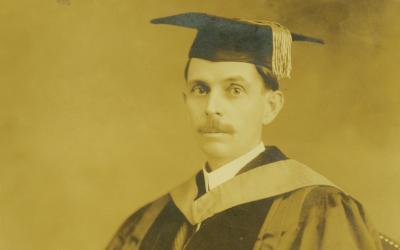
Wilson A.M. '88
was editor of the editorial pages at The Heral-Sun from
1991 to 2005
Photo:Les Todd |
Coming off New Year's weekend, the
350 employees of Durham's daily newspaper, The Herald-Sun,
who went to work as usual on January 3 knew the paper would
be sold that day to Paxton Media Group LLC, a Kentucky-based
chain. But what happened almost before the ink dried was
anything but usual in American journalism: Paxton representatives
who had met Herald-Sun employees in December with smiles
and handshakes now turned into grim Terminators as they began
cutting eighty-one jobs, seventeen of them in the newsroom.
Those who lost their jobs, including a fifty-year employee,
had mere minutes to gather their personal items before being
escorted to the door.
By the end of the day, Paxton had a "de-contented" Herald-Sun,
one rife with distrust on both sides. The job cuts would
go on until the following Friday, eventually claiming the
paper's prize-winning editorial cartoonist. The vehemence
of what happened at The Herald-Sun rippled through the Durham
community and into the newspaper industry. The drastic cuts
were necessary, Paxton spokesmen said, to make The Herald-Sun "viable."
In most corporate takeovers of independent newspapers, the
incumbent staff--publisher, editor, and others in management--can
expect a probationary period with the new organization. Changes
come incrementally, not as a pre-emptive strike.
Yet, by whatever means a newspaper loses its independence,
its entrance into the fold of chain journalism imposes fundamental,
irreversible changes. Its corporate master may be half a
continent away, as in the case of Paxton Media Group. The
new owners have no ties to the local community and, in most
cases, few incentives to create them. The chain's goal is
maximum profit, not maximum quality.
Lost in transition is the vital duality of American newspapers:
They are both a business and an institution. The business
belongs to the corporation, but the institution belongs to
the readers--or should. This feeling of violation by a faceless
entity fed outcries of concern in Durham that lasted for
weeks. Many longtime Herald-Sun readers feared that Paxton's
announcement that the paper would henceforth concentrate
on local news was the first step in reducing a full-spectrum,
award-winning newspaper to an outlet for fluff-and-puff journalism.
Corporate journalism was unknown to the Founders when they
crafted the most important guarantee of free speech in history,
the First Amendment. Although some, such as Thomas Jefferson,
suffered unfairly at the hands of a partisan independent
press, the Founders looked beyond such petty sniping to the
importance of unfettered speech in the political, economic,
and social progress of the new republic. The press was to
be the people's surrogate, the sentinel of government. In
the nineteenth century, crusading editors added a corollary: "Comfort
the afflicted and afflict the comfortable."
Size offers no immunity for an independent newspaper. In
2000, the parent company of the Chicago Tribune bought the
Los Angeles Times for $8 billion. About the same time, The
New York Times acquired The Boston Globe. Gannett bought
The Des Moines Register (then edited by Geneva Overholser,
sister of former Duke President Nan Keohane). For many large
independents, it was the era of the Great Consolidation.
In rare cases, corporate ownership improves a newspaper.
Raleigh's News & Observer, bought in 1995 by California-based
McClatchy Newspapers, has become North Carolina's pre-eminent
daily. McClatchy regards quality and profitability as complementary,
not exclusive. The result is a stable of twelve mid-size
newspapers that consistently rank among the nation's best.
As a rule, U.S. newspaper chains seek properties in cities
where competition is low or, preferably, nonexistent. Paxton's
entry into the Triangle market breaks that rule. Consequently,
Durham readers now have more choice than before January 3:
They can spend their 50 cents on a shrinking Herald-Sun or
on a growing News & Observer.
In this respect, Durham's newspaper readers are more fortunate
than their counterparts in other North Carolina cities. Over
the past twenty years, corporate takeovers of the state's
major independent dailies--only The Fayetteville Observer
remains in family ownership--have reduced such bulwarks of
quality journalism as the Winston-Salem Journal and Greensboro's
News & Record to shadows of their former greatness. Even
The Charlotte Observer, a crown jewel in the Knight-Ridder
newspaper empire, no longer bestrides the Carolinas as it
did for decades.
There is a curious paradox in this decline of newspapers,
for more than 200 years America's broadband, random-access
medium. On the whole, the nation's 1,457 dailies (of which
about 324 are still independent) remain immensely profitable,
even though net circulation has been falling in response
to changing demographics for fifteen years. The major chains'
average pre-tax profit in 2002 was 19 percent, much higher
than most other businesses. Some chains earn pre-tax profits
of 30 percent or more.
What's behind the paradox? Display and classified ads. No
daily newspaper makes money on rack sales and subscriptions.
But no other medium, not even television, can provide advertisers
such a convenient one-stop venue for a certified audience.
This much, however, is clear: Good newspapers, those that
take their quasi-public role seriously while giving their
readers diversified content, are much better candidates for
survival than those that take the advertising dollars and
run. Speaking through Tom Sawyer, Mark Twain said, "the
newspapers fetches you the troubles of everybody all over
the world." And so the best of them do, 365 times a
year. In the interest of an informed citizenry and open government,
we need them as never before.†
Wilson A.M. '88 was editor of the editorial pages at The Herald-Sun from 1991 to 2005.
. |